


Built from an emergency medicine bottleneck

Designed for the moment when you need visual acuity now.

QuickAcuity exists because waiting on a traditional workflow to get a usable visual acuity result is often slower than the rest of the encounter. The app is meant to compress that delay without pretending a smartphone is a full refraction suite.

Download QuickAcuity on the App StoreGet QuickAcuity on Google Play
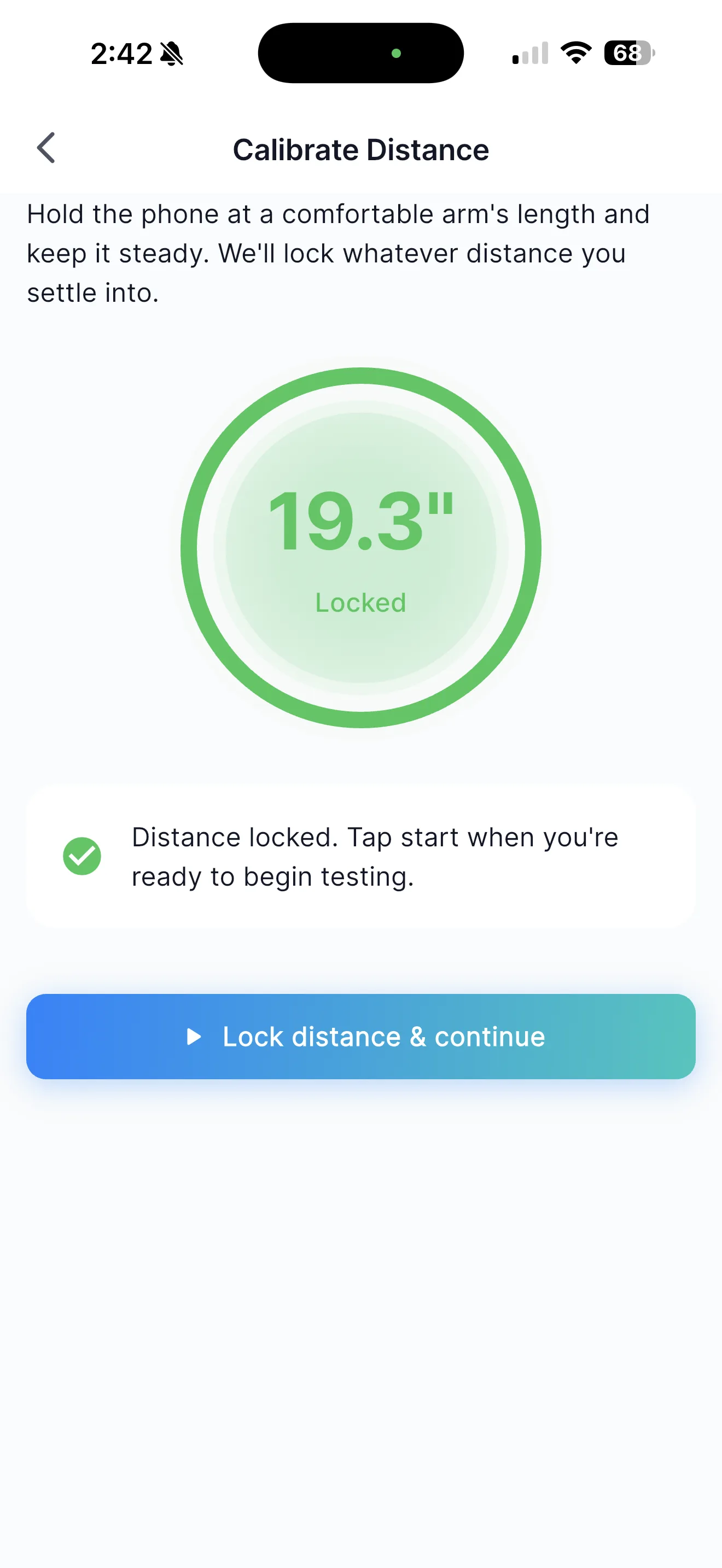
QuickAcuity distance calibration screen

Who it is for

Clinical settings where speed matters.

  • Emergency departments that need a fast bedside visual acuities
  • Urgent care and telehealth workflows where wall charts are inconvenient
  • School, occupational, and intake settings that need repeatable screening
  • Clinicians who want a modern alternative to waiting on a full room setup
Core promise

Fast, repeatable screening

A modern mobile workflow for capturing clinically useful acuity buckets when a bedside answer is better than delay.

Important boundary

Screening, not diagnosis

The app helps with quick acuity screening. It should not be presented as a substitute for a comprehensive professional exam.

Clinical proof

Why QuickAcuity is built around Landolt C.

Landolt C is not a branding choice. It is the reference optotype behind standardized acuity testing, and it solves several of the structural problems built into classic Snellen charts when the goal is a cleaner screening measurement.

What it is

Landolt C measures gap resolution

Landolt C broken ring optotype with the gap opening to the right
This broken ring is a Landolt C. The opening rotates up, down, left, or right, and the patient identifies that direction.

The task is simple: identify the direction of the gap in a broken ring. ISO 8596 uses the Landolt ring as the reference optotype for acuity measurement, so the result is anchored to a standardized visual target rather than letter recognition. [1]

Why it improves on Snellen

A more standardized acuity task

Classic Snellen charts mix letters with unequal legibility, inconsistent spacing, and irregular progression between lines. Modern chart design principles were created to correct those weaknesses with equalized difficulty, fixed spacing, and logarithmic size steps. [2, 3]

Why clinicians use it

Language-independent by design

Because the response is directional instead of alphabet-based, Landolt C works without assuming English literacy. That makes instructions shorter, reduces confounding from letter knowledge, and fits better in fast, mixed-population screening settings. [1, 5]

Digital evidence

Screen-based Landolt C testing has clinical precedent

Computerized logMAR systems validated against ETDRS showed no significant bias and test-retest variability around +/-0.10 to +/-0.12 logMAR. A 2023 handheld smartphone study using a crowded Landolt C with four-direction swipe input also found no significant difference from clinic measurement, with mean differences under one line. [4, 5]

Important boundary

Evidence for the method, not a substitute for the exam

The studies above support the choice of a standardized Landolt-C task and controlled digital presentation. That is indirect evidence for QuickAcuity's design, not a claim that a phone replaces refraction, slit-lamp findings, intraocular pressure, or the rest of a comprehensive ophthalmic evaluation. [3, 4, 5]

Sources

  1. [1] International Organization for Standardization. ISO 8596:2017. Ophthalmic optics — Visual acuity testing — Standard and clinical optotypes and their presentation. View source
  2. [2] Bailey IL, Lovie JE. New design principles for visual acuity letter charts. American Journal of Optometry and Physiological Optics. 1976;53(11):740-745. View source
  3. [3] Kaiser PK. Prospective Evaluation of Visual Acuity Assessment: A Comparison of Snellen Versus ETDRS Charts in Clinical Practice. Transactions of the American Ophthalmological Society. 2009;107:311-324. View source
  4. [4] Laidlaw DAH, Tailor V, Shah N, Atamian S, Harcourt C. Validation of a computerised logMAR visual acuity measurement system (COMPlog): comparison with ETDRS and the electronic ETDRS testing algorithm in adults and amblyopic children. British Journal of Ophthalmology. 2008;92(2):241-244. View source
  5. [5] Ogino M, Salmeron-Campillo RM, Hunter S, Hussey V, Rodriguez-Vallejo M. Clinical validation of a novel smartphone application for measuring best corrected visual acuity. Journal of Optometry. 2023;16(3):206-213. View source

Try the workflow

Download QuickAcuity free and test it yourself.

If this is relevant to your practice, the fastest way to evaluate it is to try the app directly on your own phone. No chart room, no wall setup, and no signup required.

Download QuickAcuity on the App StoreGet QuickAcuity on Google Play

Editorial review

Medically reviewed by William Dirkes, MD, FAAEM for QuickAcuity, published by Dirkes Medical, PLLC.

Reviewed March 15, 2026Updated March 15, 2026